
The Tax Deadline Passed. Now What?
- Apr 6
- 4 min read

7 Smart Moves Every Miami Business Owner Should Make in April
April 15 is behind you.
You filed (or filed an extension), you paid what you owed, and you closed that chapter — at least for now.
But here's what most business owners don't realize: the weeks right after tax season are actually the most important time of the year for your finances. Not December. Not January. April.
Why? Because right now, you know exactly what you paid, what surprised you, and what you wish you had done differently. That clarity is rare — and it doesn't last long.
At BIZ CPAs Miami, we work with business owners across Florida, Latin America, and Europe, and every year we see the same pattern: people who take action in April pay dramatically less in taxes the following year. People who wait until next March? They're surprised all over again.
Here are 7 moves to make right now.
Move 1: Sit With Your Numbers — Honestly
Before you do anything else, look at what you actually paid this year. Not just the refund or the balance due — the full picture. Total tax liability. Effective tax rate. What percentage of your revenue went to the IRS.
If that number shocked you, that's information. It means your current accounting strategy isn't working hard enough for you.
💡 Ask yourself: If I had known in January what I know now, what would I have done differently? |
Move 2: Adjust Your Q2 Estimated Tax Payments
If you're self-employed or run a business, you likely have quarterly estimated taxes due. The Q2 deadline is June 15, 2026 — and most business owners either underpay or completely ignore this.
Underpaying means a penalty. Overpaying means you're giving the IRS an interest-free loan. Neither is good.
A proactive CPA will look at your Q1 revenue, your current trajectory, and calculate the right payment amount — not just what the software suggests based on last year.
📅 Q2 Estimated Tax Deadline: June 15, 2026. Don't let it sneak up on you. |
Move 3: Review Your Business Entity Structure
This is one of the highest-impact moves you can make — and one of the most overlooked.
If you're running your business as a sole proprietor or single-member LLC, you're paying self-employment tax on 100% of your net profit. That's 15.3% on top of income tax. An S-Corp election could legally eliminate a significant portion of that.
Example: A business owner earning $180,000 in net profit as a single-member LLC pays roughly $25,000 in self-employment tax. The same business structured as an S-Corp could reduce that to $10,000–$12,000. That's a $13,000 difference — every year.
The right structure depends on your revenue, expenses, and goals. This is exactly the kind of conversation to have with a CFO advisor, not just a tax preparer.
Move 4: Start Your Bookkeeping Now — Not in January
We know. You just finished taxes and the last thing you want to think about is bookkeeping. But here's the truth: clean books in April mean no panic in March.
More importantly, real-time bookkeeping gives you visibility into your finances that last year's numbers can't. You can't make strategic decisions based on data that's 4 months old.
What clean monthly books give you:
• A clear picture of cash flow — no surprises on payroll or vendor invoices
• Visibility into which services or products are actually profitable
• Data to make confident decisions about hiring, pricing, and growth
• A foundation for quarterly tax planning — not reactive filing
Move 5: Identify the Deductions You Missed This Year
Most business owners leave deductions on the table — not because they're not entitled to them, but because they didn't document them properly or didn't know to claim them.
Common missed deductions for small business owners:
• Home office deduction (even partial use qualifies)
• Vehicle mileage for business use
• Professional development, courses, and conferences
• Health insurance premiums for self-employed owners
• Retirement plan contributions (you can still fund a SEP-IRA for 2025)
• Business meals and entertainment (50% deductible when properly documented)
• Software, subscriptions, and tools used for the business
The key word is documented. A deduction without documentation is just a number on a spreadsheet that the IRS can disallow. Your CPA should be helping you build the habit of capturing these throughout the year — not hunting for them in March.
Move 6: Open (or Maximize) a Retirement Plan
This might be the single best legal tax reduction strategy available to small business owners — and most people dramatically underuse it.
Here's why: contributions to qualified retirement plans (Solo 401(k), SEP-IRA, Defined Benefit Plan) reduce your taxable income dollar for dollar. And in some cases, the contribution limits are substantial.
2026 Contribution Limits at a Glance Solo 401(k): up to $70,000 total (employee + employer contributions) SEP-IRA: up to 25% of net self-employment income Defined Benefit Plan: potentially $200,000+ for higher earners |
If you're not maximizing a retirement plan, you're paying taxes on income that could be working for your future instead. Talk to your CPA about which vehicle makes the most sense for your situation.
Move 7: Book a CFO Strategy Session Before Summer
Here's the honest truth: most of the moves above require a strategic conversation, not just a checklist. The right answer for your business depends on your revenue, your structure, your goals, and your timeline.
That's why we offer a free 30-minute strategy call — not to pitch you, but to actually look at your situation and tell you where the real opportunities are. Sometimes it's an entity restructure. Sometimes it's a retirement plan. Sometimes it's just getting your books in order so you can see clearly.
The business owners who consistently pay less in taxes aren't doing anything illegal or complicated. They just have someone in their corner who's thinking ahead — not just reacting to what already happened.
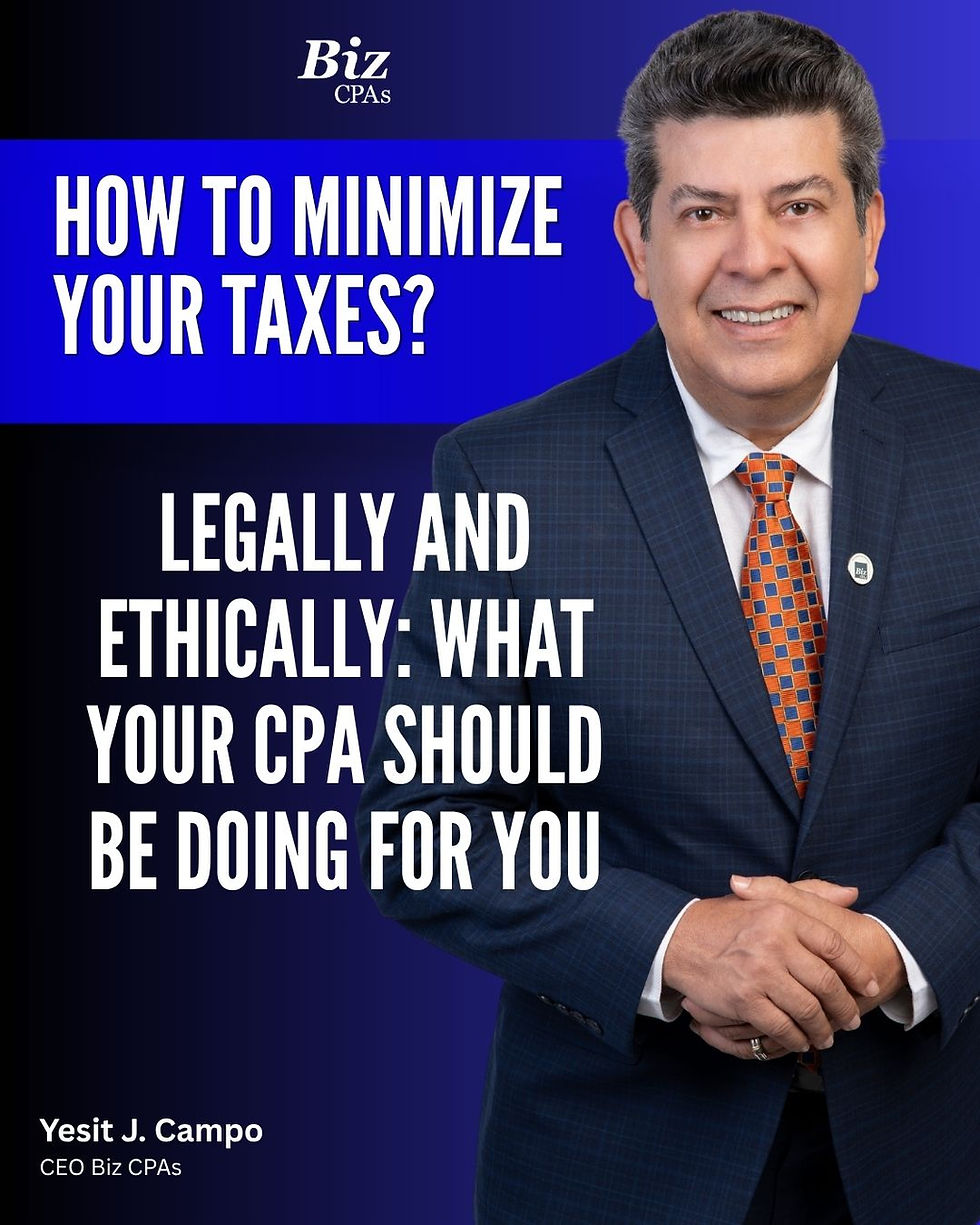
"I ensure my clients view my service as an investment, never a cost." — Yesit J. Campo, CPA · Founder & CEO, BIZ CPAs Miami |
Ready to Stop Overpaying in Taxes? Book a FREE 30-minute strategy call with Yesit J. Campo, CPA. No pitch, no pressure — just a real conversation about your financial situation. |


Comments