
When Selling Receivables Is Really Financing: ASC 860 vs. ASC 470
Technical Accounting & CFO Insight
ASC 860 • Transfers & Servicing | ASC 470 • Debt

A business needs working capital. Instead of taking out a traditional bank loan, it receives cash today in exchange for a portion of the cash it expects to collect from customers tomorrow. Simple enough—but what exactly happened?
Did the company sell receivables that already existed? Did it transfer receivables while retaining so much control that the transaction is really a secured borrowing? Or did it sell rights to future revenue that has not yet been earned?
Each answer produces a different result under U.S. GAAP. One transaction falls under ASC 860, Transfers and Servicing. Another falls under ASC 470, Debt. Getting the classification wrong can distort working capital, leverage, operating and financing cash flow, profitability, EBITDA-to-cash conversion, debt-service capacity, and ultimately a quality-of-earnings analysis.
Key Takeaways
Start with the asset. ASC 860 applies only to transfers of recognized financial assets, such as invoiced receivables. Rights to future revenue are evaluated under ASC 470.
Control drives ASC 860. If the seller does not surrender control, a "sale" of receivables is accounted for as a secured borrowing.
Revenue-based financing is usually debt. Proceeds are not revenue, and the financing cost is recognized over time using the interest method—not expensed on Day 1.
Current is not the same as operating. A current financing liability belongs in financing cash flows, not in working-capital movements.

The First Question: Does the Receivable Already Exist?
Suppose a logistics, installation, healthcare, construction, or professional-services company has already performed work for a customer, issued an invoice, and is owed $500,000. That receivable already exists as a recognized financial asset. If the company transfers it to a finance company, ASC 860 applies.
Now change the facts. The company has not yet performed the services. A capital provider advances $500,000 today in exchange for a percentage of the customer collections the business expects to generate over the coming year. Those future collections are not yet recognized receivables, so the arrangement is evaluated under ASC 470.
CPA Perspective: The contract title is not the accounting conclusion. Terms such as "factoring," "advance," "purchase of future receipts," "revenue-based financing," or "line" describe a commercial arrangement. GAAP requires an analysis of its economic substance.
ASC 860: When Existing Receivables Are Transferred
ASC 860 governs transfers and servicing of financial assets. When a company transfers existing trade receivables, the central question is whether it has surrendered control. Sale accounting generally requires all three of the following conditions:
Legal isolation. The transferred receivables are beyond the reach of the seller and its creditors, even in bankruptcy or receivership.
Right to pledge or exchange. The buyer can pledge or exchange the assets it received, without constraints that provide more than a trivial benefit to the seller.
No effective control retained. The seller has no repurchase agreement, call option, or other mechanism that allows it to keep effective control of the receivables.
When only a portion of a receivable is transferred, that portion must also meet the definition of a participating interest to qualify for sale accounting.
Example 1: A True Sale Under ASC 860
A business transfers $1,000,000 of existing accounts receivable to an unrelated purchaser for $960,000 in cash. For simplicity, assume no retained interests, guarantees, recourse, or servicing assets or liabilities.
Account | Debit | Credit |
|---|---|---|
Cash | $960,000 | |
Loss on sale of receivables | $40,000 | |
Accounts receivable | $1,000,000 |
Result: The receivable leaves the balance sheet, no borrowing liability is recorded, and the $40,000 discount is recognized in earnings.
Example 2: When Sale Accounting Fails
If the same receivables are transferred but control is not surrendered, the seller continues to recognize the receivables and records the proceeds as a secured borrowing.
Account | Debit | Credit |
|---|---|---|
Cash | $960,000 | |
Secured borrowing | $960,000 |
Result: Accounts receivable remains on the balance sheet alongside a new $960,000 financing liability. The cash in the bank is identical to Example 1, but leverage, the balance sheet, and the cash-flow statement tell a very different story.
ASC 860 vs. ASC 470 at a Glance
ASC 860 – Transfers and Servicing | ASC 470 – Sales of Future Revenue | |
|---|---|---|
What is transferred | Existing, recognized financial assets (e.g., invoiced receivables) | Rights to revenue not yet earned or recognized |
Key test | Has the seller surrendered control? | Do debt indicators exist (continuing involvement, capped return, recourse)? |
Possible outcomes | Sale (derecognize) or secured borrowing | Debt (most common) or deferred income |
Balance-sheet effect | Receivable removed, or retained with a liability | Financing liability, or deferred income |
Cost recognition | Gain or loss at transfer, or interest over time | Interest expense using the interest method |

ASC 470: Monetizing Future Revenue
Consider a business that receives a lump sum today in exchange for a percentage of future customer receipts until a fixed amount has been delivered. Payments may be daily, weekly, or tied to collections, and the contract may describe the transaction as a "purchase" rather than a loan.
Under ASC 470-10, management determines whether the proceeds should be recorded as debt or deferred income. The guidance creates a rebuttable presumption of debt when any of the following indicators are present:
The transaction does not purport to be a sale.
The company has significant continuing involvement in generating the cash flows.
Either party can cancel the arrangement through a lump-sum payment or other transfer of assets.
The investor's rate of return is explicitly or implicitly capped.
Variations in the company's revenue have only a trifling effect on the investor's return.
The investor has any recourse to the company.
A practical test: If the business stopped operating tomorrow, would the purchaser still own a pool of existing receivables it could collect? Or does the investor depend on the company continuing to operate and generate new revenue?
Example 3: Revenue-Based Financing
A business receives $500,000 today and expects to remit $620,000 over approximately twelve months, based on a percentage of future customer collections.
Account | Debit | Credit |
|---|---|---|
Cash | $500,000 | |
Revenue-based financing liability | $500,000 |
Result: The company does not record $500,000 of revenue—it obtained financing, not operating income. The $120,000 spread is not expensed on Day 1; under the debt model it is recognized as interest expense over the expected term using the interest method.
Why the Interest Method Matters to the P&L
Expensing the entire financing premium immediately understates early-period earnings and overstates later-period earnings. An effective-interest schedule recognizes the cost over the life of the obligation, in line with its economics. That difference flows directly into monthly EBITDA, margins, covenant calculations, valuation, bonuses, and forecasts.
What About Deferred Income?
Debt is not the only possible outcome. When the debt presumption is overcome, proceeds are recorded as deferred income and recognized using a units-of-revenue approach. In practice, this outcome is uncommon for revenue-based financing arrangements.
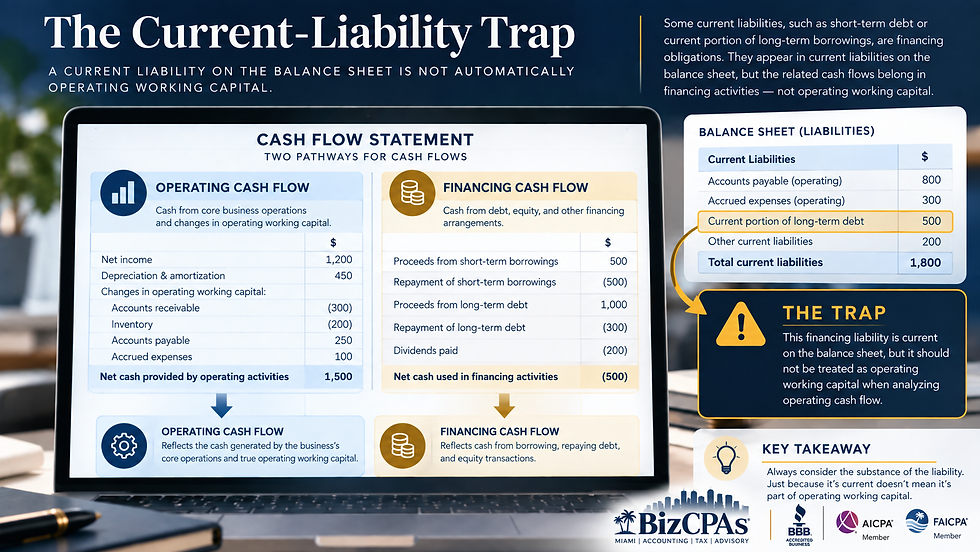
The Current-Liability Trap
A financing obligation expected to settle within twelve months may properly be classified as a current liability. But current classification does not make it an operating liability.
Operating current liabilities: trade accounts payable, accrued payroll, and ordinary operating accruals.
Financing current liabilities: current portions of term debt, revolving credit, short-term notes, and revenue-based financing.
How a Spreadsheet Can Invent Operating Cash Flow
Assume the company correctly records the $500,000 of cash and a current financing liability. If the cash-flow workbook uses the shortcut "increase in current liabilities = operating cash inflow," it will report financing proceeds as cash generated from operations.
No customer paid faster. No margin improved. No vendor extended terms. The company simply borrowed—and the model confused capital structure with operating performance.
Why It Matters in a Real Business
A company reports $4.5 million of EBITDA and $4.0 million of operating cash flow—apparently excellent cash conversion. But if $800,000 of that operating cash flow actually came from financing liabilities included in working-capital movements, normalized operating cash flow is closer to $3.2 million.
EBITDA did not change. The quality of the cash supporting it did. That affects valuation, lending capacity, debt-service coverage, normalized working capital, net debt, and quality-of-earnings conclusions.
A Better Cash-Flow Architecture
Operating working capital should focus on accounts receivable, inventory, prepaids, accounts payable, accrued payroll, and ordinary operating accruals.
Financing accounts—revolvers, current portions of term debt, short-term notes, and revenue-based financing—should be mapped separately.
Borrowing proceeds and principal repayments are financing cash flows. Under U.S. GAAP, interest paid is generally an operating cash outflow.
Cash from a true sale of trade receivables is generally an operating inflow, while proceeds from a secured borrowing are a financing inflow.
Don't fix cash flow by reclassifying debt as long-term. Moving a financing account to long-term liabilities may make the spreadsheet look better while making the balance sheet less accurate. Current-versus-noncurrent classification and operating-versus-financing classification are separate questions. Fix the cash-flow mapping instead.
The Quality-of-Earnings Question
These classifications become especially important in a transaction. A buyer's quality-of-earnings team will ask whether a revenue-based financing arrangement is debt, a debt-like item, a working-capital adjustment, or an obligation that reduces purchase price. Proper GAAP accounting gives both sides a cleaner starting point for that negotiation.
Five Questions Management Should Ask
Does the receivable exist today? If not, ASC 860 is not the right starting point.
If it exists, did we surrender control? Review legal isolation, transferee rights, repurchase features, guarantees, and continuing involvement.
If we are monetizing future revenue, does ASC 470 point to debt? Evaluate continuing involvement, recourse, return caps, cancellation features, and overall economics.
How is the financing cost recognized? Use the interest method rather than expensing the entire spread on Day 1.
Does our cash-flow model separate operating working capital from financing? If not, free cash flow may be telling the wrong story.
The Bigger Lesson: Follow the Economics
A company can receive the same $500,000 under three arrangements and produce three different sets of financial statements: a true sale of an existing receivable, a secured borrowing against that receivable, or financing against revenue it has yet to generate.
Same cash. Different economic substance. Different accounting.
What asset exists? Who controls it? Who bears the risk? Who must create the future cash flow?
Answer those questions, and the accounting becomes clear—along with the financial story presented to owners, lenders, buyers, and investors.
How BizCPAs Can Help
Modern financing arrangements are evolving faster than many bookkeeping systems and chart-of-accounts structures. Our accounting and fractional CFO team helps businesses record these transactions correctly and understand how they shape the financial statements used for decisions, including:
GAAP classification of receivables transfers and revenue-based financing
Debt and working-capital presentation
Operating versus financing cash-flow mapping
Effective-interest schedules and financing-cost recognition
EBITDA and free-cash-flow reconciliation, lender reporting, and quality-of-earnings preparation
Accurate accounting should do more than balance—it should explain what is actually happening inside the business. Contact BizCPAs to review your financing arrangements before your next lender report, audit, or transaction.
Technical References
FASB ASC 860, Transfers and Servicing
FASB ASC 470-10, Debt (Sales of Future Revenue)
FASB ASC 835-30, Interest – Imputation of Interest
FASB ASC 230, Statement of Cash Flows
Deloitte Roadmaps: Transfers and Servicing of Financial Assets; Debt (Sales of Future Revenues)
EY Financial Reporting Developments: Transfers and Servicing of Financial Assets
Disclaimer: This article is provided for general educational purposes only and does not constitute accounting, audit, tax, legal, investment, or other professional advice. The proper accounting for any financing arrangement depends on its complete contractual terms and specific facts and circumstances.


Comments